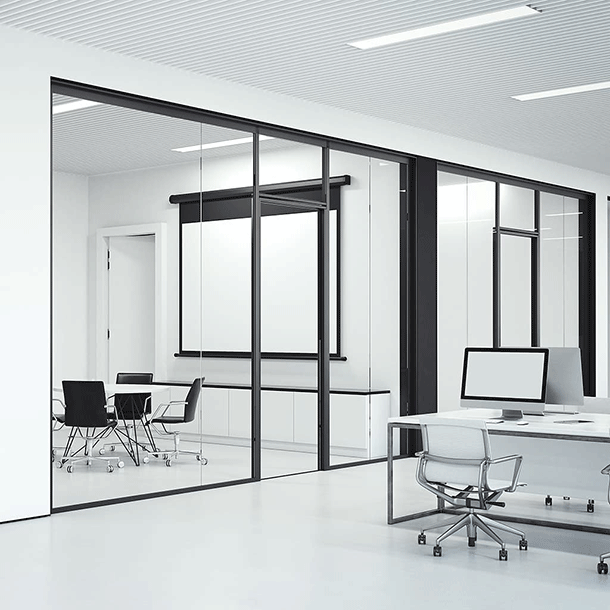
There is a real theory behind the wave of premium office redesigns happening across North America right now. It goes something like this: if you build a space that is genuinely better than working from a home office, people will choose to come in. Not because they have to, but because the commute is worth it.
Interior Design magazine's April 2026 Giants of Design roundup makes that theory tangible. Eight flagship projects by firms like Gensler, Perkins&Will, Skidmore Owings & Merrill, and Rockwell Group show a design community investing seriously in that idea: atrium living rooms, wellness amenities, divisible collaboration spaces, premium materials, biophilic elements, and programming flexible enough to serve focused work in the morning and a town hall by afternoon. These are spaces designed to make the commute.
But there is a gap between a beautifully designed office and one that actually feels good to work in all day. And it often comes down to something that does not show up in the renderings.
The Materials That Make an Office Look Great Tend to Make It Sound Terrible
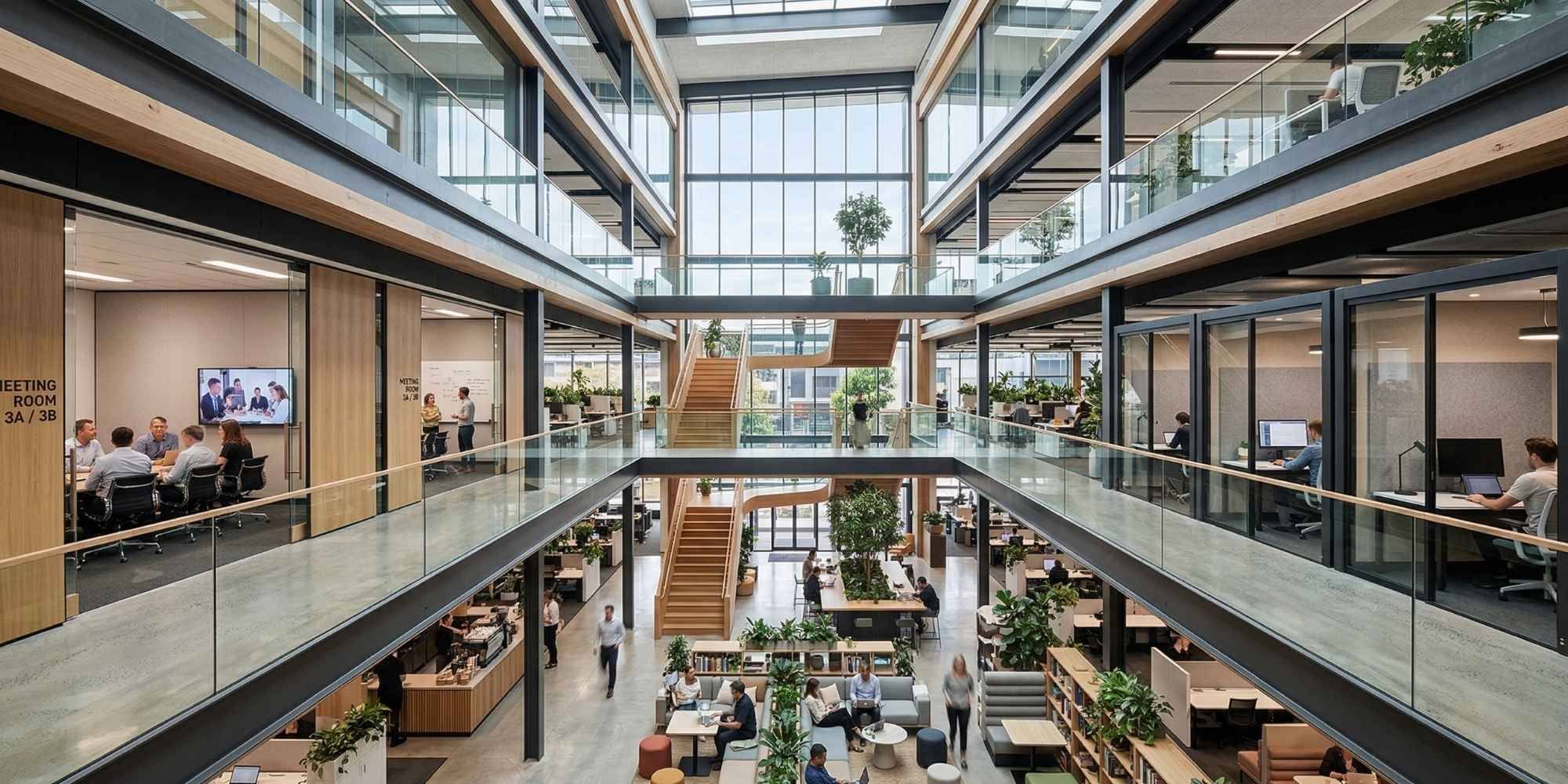
The aesthetic language of the current design moment is hard, reflective, and open. Polished terrazzo, glass-fronted rooms, limestone stairs, aluminum paneling, mass-timber ceilings. These surfaces are visually rich, sustainable, and aligned with WELL Building Standard and LEED principles around material honesty and biophilic connection. They are also acoustically unforgiving. Sound reflects off every one of them.
Add to that the spatial logic of modern workplace design, open atrium cores, divisible rooms, lounge zones adjacent to focus areas, and you have an environment where conversations carry, distractions accumulate, and the sense of privacy that makes people feel comfortable having a sensitive discussion simply disappears.
This is not a design flaw. It is a predictable consequence of the choices that make these spaces beautiful. The problem is that acoustic performance is still treated as a finishing detail rather than a foundational system, specified late, budgeted lightly, and rarely calibrated after occupancy.
Right-sizing Has Raised the Acoustic Stakes
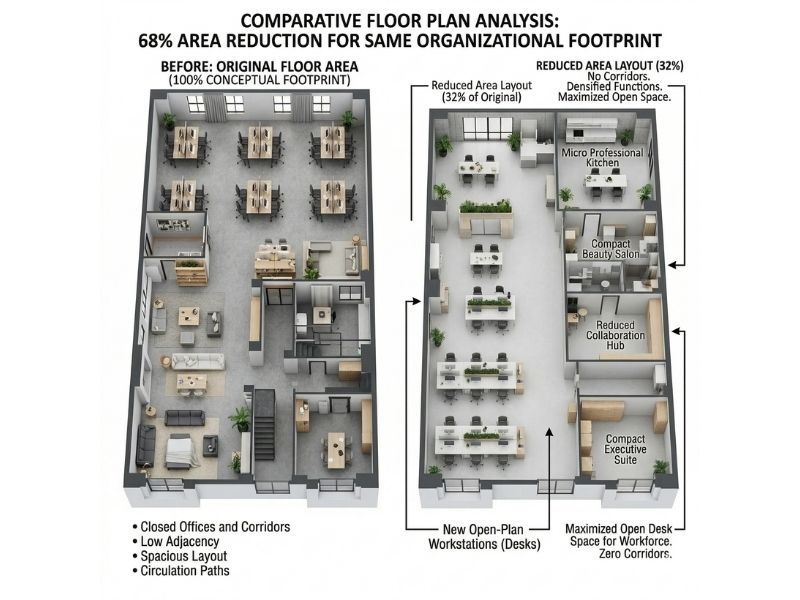
The Unilever headquarters redesign by Perkins&Will, highlighted in the Interior Design roundup, tells a story that is playing out across corporate real estate right now. The company condensed its U.S. offices from 350,000 square feet in the suburbs to 111,000 square feet in a downtown waterfront building. Same organization, 68% less floor area. That compression eliminates the buffers: the long corridors, the closed offices, the incidental distance between functions that used to provide acoustic separation almost by accident.
When those buffers disappear, passive acoustic measures reach their limits fast. Upholstered furniture, carpet tile, and acoustic ceiling panels all reduce reverberation, which helps. But reverberation control and speech privacy are different problems. Absorptive materials address the former. Only actively raising the ambient noise floor addresses the latter, which is exactly what sound masking does: it introduces a spectrally shaped, barely perceptible background signal that reduces the intelligibility of nearby speech, making conversations private without requiring physical separation.
If the Acoustics Fail, the Whole Investment Fails
Here is the part that does not get said enough. A company can spend millions on a workplace redesign, get the design press coverage, win the employee experience survey in the first month, and then quietly watch utilization drop back to pre-renovation levels by Q3 because people discovered that the beautiful open lounge is too loud to concentrate in, that the glass-fronted meeting room offers zero confidentiality, and that taking a sensitive call means finding a stairwell.
According to Gensler's 2026 Workplace Survey, the ability to focus is consistently the top factor employees cite when evaluating whether a workplace supports their productivity. Not the coffee bar. Not the standing desks. Focus. And focus is an acoustic problem as much as a spatial one.
The commute has to be worth it every day, not just on the first Tuesday after the ribbon cutting.
Choosing the Right System Matters More Than Most Specs Acknowledge
Sound masking is not a single product category. There is a meaningful difference between systems, and specifying the wrong one is a common and costly mistake.
The fundamental question is whether the system can be properly calibrated after installation. A sound masking signal that is too loud becomes its own distraction and generates complaints. One that is too quiet or unevenly distributed leaves acoustic dead zones where speech privacy breaks down entirely. Research published by the Acoustical Society of America consistently shows that the effectiveness of sound masking depends less on the hardware than on the precision of the calibration and the uniformity of the coverage.
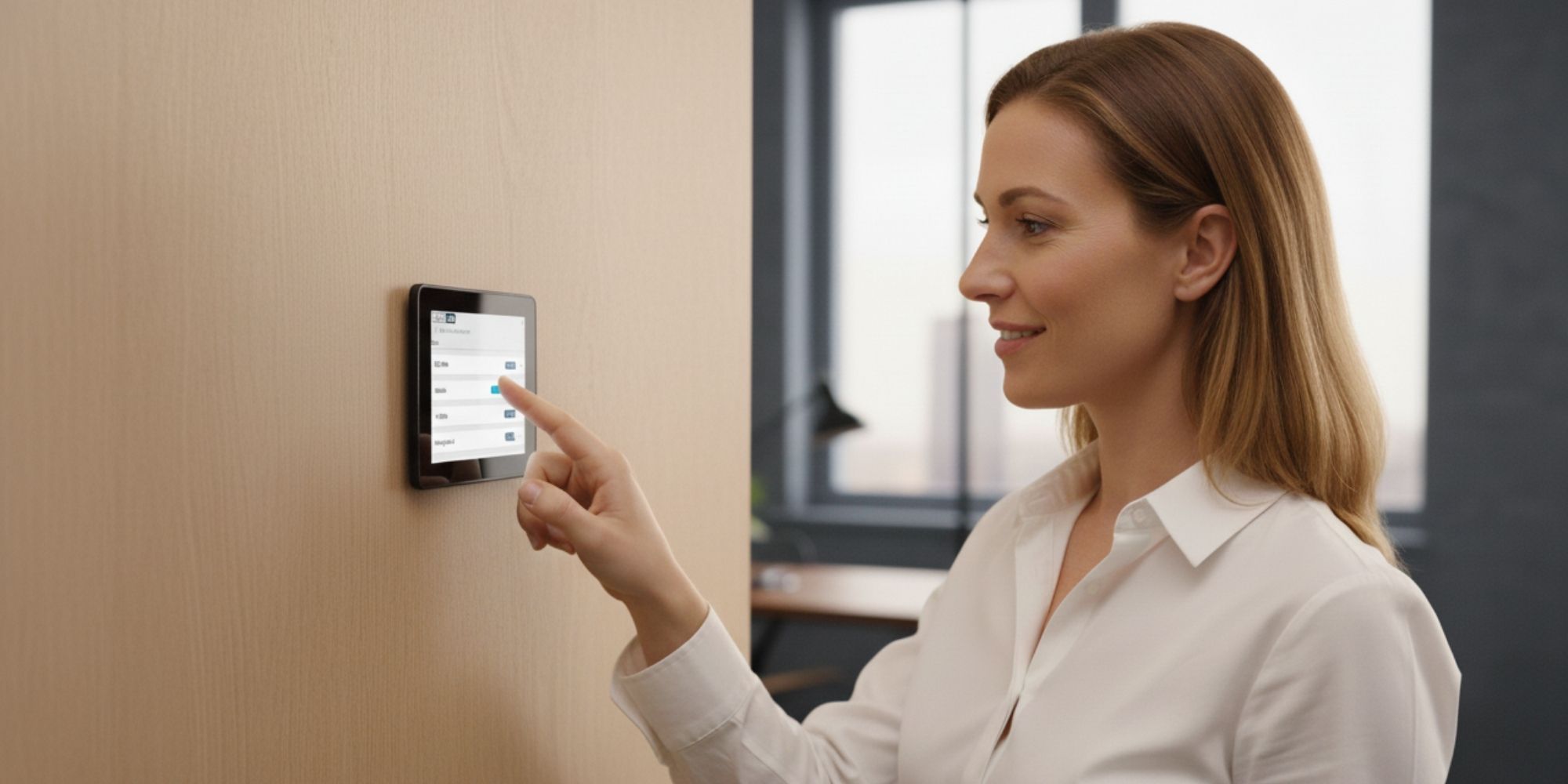
Modern systems like those from Soft dB allow facility managers to define independent acoustic zones, adjust masking levels and frequency profiles per zone, and schedule changes throughout the day through revolutionary software, all without touching the ceiling. When the training room divides for a confidential session at 2 p.m. and reopens as a collaboration space at 4 p.m., the acoustic layer adjusts with it. That kind of adaptive control is not a premium add-on. It is what makes the system function as designed in a real occupied building rather than a staged product demo. For environments where privileged conversations are a daily operational requirement, that level of zone control is not a convenience feature. It is a compliance consideration.
Installation Is Simpler Than Most Facility Managers Expect
One reason sound masking gets deferred or descoped is the assumption that it requires significant construction. It does not. A distributed in-ceiling masking architecture typically installs in parallel with standard electrical and low-voltage work, with no structural modification and no visible hardware beyond small emitters that sit flush with or above the ceiling plane. For retrofit projects, the footprint is even lighter. There is no demolition, no drywall work, and no disruption to the design intent that the architect and interior designer spent months developing.
At end-of-lease or reconfiguration, the system can be adjusted, expanded, or relocated without leaving a trace on the space.
The Design Intent and the Acoustic Performance Have to Be Specified Together
The offices featured in Interior Design's Giants of Design roundup represent a genuine commitment to creating workplaces that are worth showing up for. The investment in materiality, flexibility, wellness programming, and sustainability is real and serious. What completes that investment is an acoustic layer that allows those spaces to deliver on their promise every day, not just when they are empty and photographed.
Sound masking is not a patch on a design problem. It is the infrastructure that makes open, beautiful, flexible spaces also function as private, focused, and professionally effective environments. The two are not in conflict. They just need to be planned for at the same time.