Under Ontario's noise regulation, the first question isn't whether you hand out earplugs. It's whether anyone is exposed above 85 dBA averaged over the shift, measured as if nobody wore hearing protection, and what you've done at the source to bring that down.
This guide is for the people who have to answer that question and fund the fix: plant managers, EHS and HSE leads, and operations directors at Ontario facilities. It covers what O. Reg. 381/15 actually requires (less than many summaries claim, and more than many plants do), when hearing protection alone is acceptable, how 10- and 12-hour shifts change the math, and what to have on file when an inspector, a complaint or a hearing-loss claim arrives.
The regulation has been in force since July 1, 2016 and applies to every workplace covered by Ontario's Occupational Health and Safety Act (OHSA).
What O. Reg. 381/15 Actually Requires
The regulation is short. These obligations do most of the work:
| Requirement | What the regulation says | What it means on your floor |
|---|---|---|
| General duty (s. 2(1)) | Take all measures reasonably necessary in the circumstances to protect workers from exposure to hazardous sound levels | The baseline everything else is judged against |
| The limit (s. 2(4)) | No worker exposed above 85 dBA Lex,8: the shift's total noise energy, normalized to 8 hours | It's a daily dose, not a single reading. An hour at a loud station counts toward it |
| Measured without hearing protection (s. 2(3)) | Measurements taken to decide on protective measures are done "without regard to the use of hearing protection devices" | Earplugs never make an area compliant on paper |
| Controls first (s. 2(2) and 2(5)) | Protective measures include engineering controls, work practices and, only as s. 2(5) allows, hearing protection. Workers above the limit must be protected without relying on hearing protection | Enclosures, silencers, isolation, damping, quieter equipment and layout changes come before PPE |
| Hearing protection in listed cases only (s. 2(6)) | Workers wear hearing protection where engineering controls are required but can't be used, for one of four listed reasons | See the next section |
| Warning signs (s. 2(7)) | Where practicable, a clearly visible sign at every approach to an area where sound regularly exceeds 85 dBA | You need measurements to know where that boundary is |
| Training (s. 3) | Workers given hearing protection get adequate training and instruction in its care and use: limitations, fitting, inspection, maintenance and, if applicable, cleaning and disinfection | Keep training records: they're how you show it happened |
| Device selection and use (s. 4) | Devices are selected having regard to the worker's sound levels, the device's attenuation and the manufacturer's information on use and limitations, and are used and maintained per the manufacturer's instructions | CSA Z94.2-14 is the reference the Ministry's guide points to |
Just as important for budgeting is what the regulation doesn't require. It doesn't mandate a formal noise survey of every workplace, audiometric (hearing) testing, or specific records. The guide to the regulation published by the Ministry of Labour, Immigration, Training and Skills Development says a comprehensive survey isn't necessarily needed everywhere.
But you can't show that nobody is above 85 dBA, decide where the signs go, or defend your choice of controls without measurements. And the guide says employers should keep training records and document which control measures they considered and why they didn't adopt them. That paper trail is your evidence if your choices are ever questioned.
Engineering Noise Control Comes First. Earplugs or Earmuffs Alone Are Legal in Only Four Cases.
Hearing protection is the last line of defence, not the plan. Under s. 2(5), you have to keep workers under the limit without relying on hearing protection. Section 2(6) sets out the only exceptions: workers wear hearing protection where engineering controls are required and they:
- don't exist or can't be obtained;
- aren't reasonable or practical to adopt, install or provide, because of how long or how often workers are exposed, or because of the nature of the process, operation or work;
- have temporarily broken down; or
- are made ineffective by an emergency.
Cost on its own isn't on that list, and neither is "we've always used earplugs." The broadest ground is the second one. It covers real cases, like a task done twice a year where a permanent enclosure makes no sense, or a process that can't be enclosed without stopping it. But it only holds up with a reason you can explain. Write down what you considered and why you rejected it; the Ministry's guide asks for exactly that.
What This Means When You Budget
- Rank the sources before buying anything. In many loud areas, a few machines or tasks set most of the exposure. Fixing the top two or three often moves the dose more than treating the whole room.
- A partial fix still counts. Taking a station from 92 to 87 dBA stretches the time a worker can spend there from about an hour and a half to about five hours. That can be the difference between a workable rotation and a hearing-protection-only area.
- Specify noise at purchase. Setting a noise limit in the purchase specification and asking suppliers for sound power data costs far less than retrofitting an enclosure later.
- Where hearing protection is justified, fit it to the level. Too little attenuation fails the worker; too much can cut them off from alarms and speech. Select devices against measured levels, not the highest rating on the shelf.
Noise Exposure Math That Changes Decisions
The 85 dBA limit is a daily dose normalized to 8 hours, and Ontario uses the equal-energy rule: every 3 dB increase halves the time a worker can spend at that level.
| Average level at the station | Time to reach the daily limit, without hearing protection |
|---|---|
| 85 dBA | 8 hours |
| 88 dBA | 4 hours |
| 91 dBA | 2 hours |
| 94 dBA | 1 hour |
| 97 dBA | 30 minutes |
| 100 dBA | 15 minutes |
Three Consequences for Planning Employee Noise Exposure
- Long shifts lower the bar. The Ministry's guide works the example: 83 dBA over a 12-hour shift equals 85 dBA Lex,8. A 12-hour floor averaging 84 dBA is over the limit even though no single reading looks alarming. On a 10-hour shift, 88 dBA becomes 89 dBA Lex,8.
- Short loud tasks dominate. One hour at a 94 dBA station uses the whole daily allowance before the worker does anything else. Changeovers, compressed-air cleaning, grinding and maintenance are where area surveys miss exposure, so measure the people who move, not just the rooms.
- Rotation runs out of road. Above about 95 dBA, the allowance is measured in minutes. Job rotation stops being a realistic control and the fix has to happen at the source.
What Holds Up When an Inspector, a Complaint or a Claim Arrives
The regulation lists few records, but three situations will test what you have on file:
- An inspection. Ministry inspectors can enter without notice, review records, interview workers and take their own measurements. Failing to comply with an inspector's order is an offence in its own right, separate from whatever triggered the order.
- A complaint. When workers raise noise with the joint health and safety committee or the Ministry, your measurements and control decisions are what settle it.
- A hearing-loss claim. Noise-induced hearing loss builds over years, and WSIB claims can arrive long after the exposure. Your measurements, control decisions and (if you test) audiograms from the time are the evidence, and your claims history feeds into your WSIB premiums.
What to Keep on File
- Measurements: dates, areas or roles measured, method and instrument, calibration, who measured, and the Lex,8 results.
- Control decisions: the options considered for each major source, what you did, the measured result, and why anything was rejected.
- Signs: where they are, tied to the measured 85 dBA boundary.
- Hearing protection: how devices were selected, and who was trained, when.
- Re-measurements: after any change to equipment, layout, production rate or shift length.
O. Reg. 381/15 doesn't set retention periods for any of this. Because hearing-loss claims surface late, keep it for as long as anyone exposed could still file one.
The Cost of Getting Occupational Noise Control Wrong
Noise rarely makes headlines, but a noise offence carries the same penalties as any other OHSA offence. Under section 66 of the Act:
| Who | Maximum per offence |
|---|---|
| Corporation | $2,000,000 (since October 26, 2023) |
| Director or officer | $1,500,000, up to 12 months in jail, or both |
| Any other individual, including supervisors | $500,000, up to 12 months in jail, or both |
Fines are the visible part. The larger costs are usually an order with a deadline that forces a rushed fix, production disrupted while controls go in, and hearing-loss claims that keep arriving for years. A fix you plan is usually cheaper than the same fix done under an order's deadline.
Noise Limits If You Also Operate Outside Ontario
Federally regulated operations fall under the Canada Labour Code and its occupational health and safety regulations (SOR/86-304), with an 87 dBA limit. That covers sectors such as banking, telecommunications, interprovincial and international transportation, airports, ports, grain elevators and uranium mining. Everyone else follows the rules of the province or territory where the work happens, and every province and territory now uses 85 dBA.
| Jurisdiction | Limit (8 h) | Exchange rate | What's different |
|---|---|---|---|
| Ontario | 85 dBA | 3 dB | No mandated periodic assessment |
| Quebec | 85 dBA | 3 dB | Lowered from 90 dBA on June 16, 2023. Employers must assess exposure, measured by a qualified person, and repeat every five years |
| Other provinces | 85 dBA | 3 dB | Several also set a 140 dB peak limit for impulse noise |
| Federal | 87 dBA | 3 dB | Canada Labour Code, SOR/86-304 |
If you run sites in Ontario and Quebec, the limit is the same but the obligations aren't. Running both to Quebec's assessment cycle keeps one program and one set of records.
Where to Start With Noise Problems
Most plants don't need a consultant to know they have a noise problem. What they need is to measure it properly, rank the fixes and engineer the ones that work. A sensible sequence:
- Screen. Walk the floor. Where do people have to raise their voice to talk at arm's length? Which machines, tasks or areas draw complaints? If you run hearing tests, do the audiograms show early loss? The Ministry's guide names that last one as a sign a noise survey may be needed.
- Measure people, not just rooms. Area sound levels map the floor; personal dosimetry over full shifts captures what mobile workers actually absorb. CSA Z107.56 is the measurement standard. Measure without regard to hearing protection.
- Rank the sources. Identify which machines and tasks drive each role's exposure, and by how many decibels.
- Choose controls on the numbers. For each major source, compare options (enclosure, barrier, silencer, isolation, damping, replacement, layout) by expected dB reduction, cost and production impact. Record why anything was rejected.
- Protect and train where controls fall short, under the four conditions in s. 2(6), with signs at the 85 dBA boundary.
- Re-measure after the fix, and whenever equipment, layout, production rate or shift length changes.
You don't have to start with a consultant. The Ministry's guide points employers to their health and safety association, the Occupational Health Clinics for Ontario Workers, or consultants who specialize in noise assessments. A consultant earns the fee when the sources are complex, the fix needs engineering, or the results will be contested.
What a Useful Noise Assessment Gives You
Lex,8 by role or worker group, corrected for actual shift length; the 85 dBA boundary for signs; a ranked list of sources and their contribution in decibels; control options with expected reduction and rough cost; and hearing protection guidance matched to measured levels. A report that stops at area readings and a recommendation to wear earplugs hasn't done the job.
Working With Soft dB's Acoustical Consultants
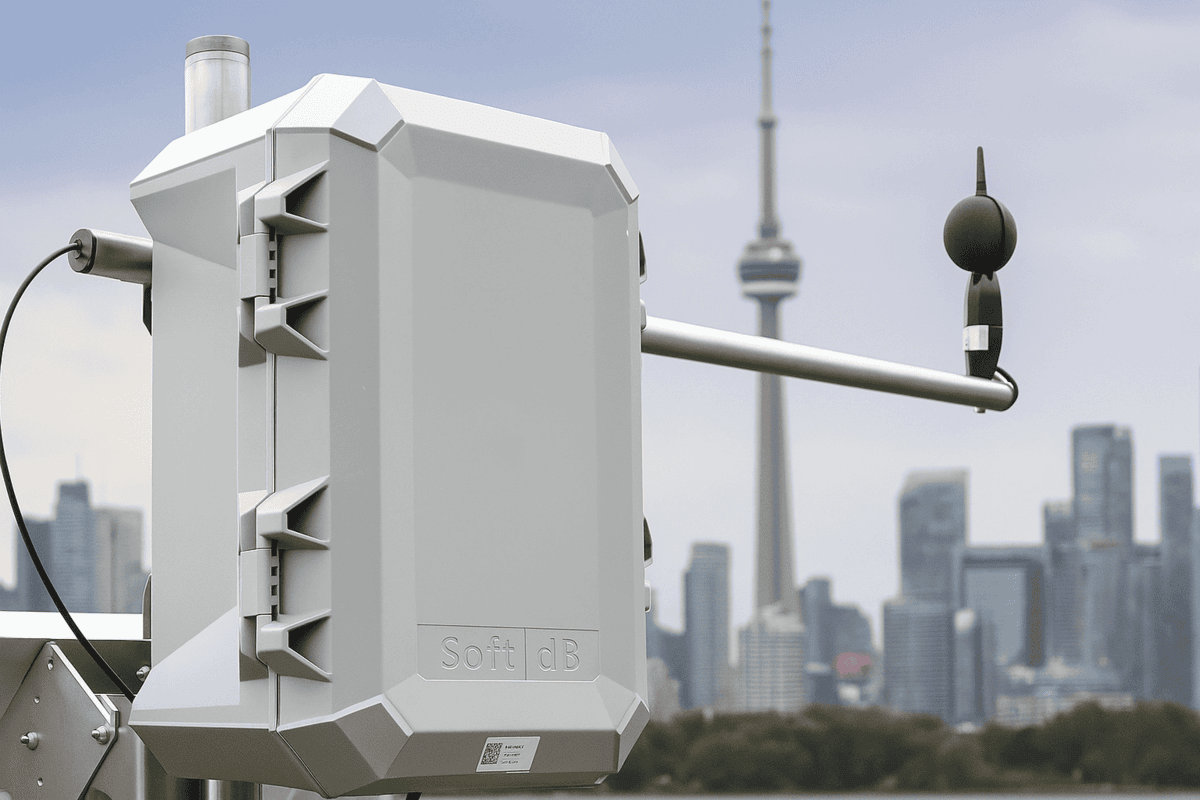
Soft dB's acoustical engineers measure, model, predict and mitigate industrial noise, from our Toronto office across Ontario. We use Class 1 instruments developed in-house by our R&D team, identify which sources drive excessive exposure, and engineer the noise controls, including the design and supply of modular acoustic enclosures for loud mission critical equipment.
The first step is usually a review of what you already have (measurements, controls, records) against O. Reg. 381/15, then a noise assessment wherever the data is missing or out of date. We'll tell you what we find, not necessarily what you want to hear.
Frequently Asked Questions About Ontario's Workplace Noise Rules
Does O. Reg. 381/15 require a noise survey of our whole plant?
Not as such. The regulation sets the limit and the order of controls, and the Ministry's guide says a comprehensive survey isn't necessarily needed in every workplace. You still need enough measurement to know which workers are above 85 dBA Lex,8, where the signs go, and whether your controls work.
Who can do the noise assessment?
The regulation doesn't say. The Ministry's guide points employers to their health and safety association, the Occupational Health Clinics for Ontario Workers, or consultants who specialize in noise assessments. Whoever does it should follow CSA Z107.56, use calibrated instruments, and report Lex,8 by role, not just area readings.
Can we rely on hearing protection instead of fixing the machines?
Only where engineering controls are required but don't exist or can't be obtained; aren't reasonable or practical because of how long or how often people are exposed, or because of the nature of the process, operation or work; have temporarily broken down; or are made ineffective by an emergency (s. 2(6)). Cost on its own isn't one of those grounds. If you rely on one, document why.
Can job rotation be our main control?
It can be part of it. Rotation is a work practice, which s. 2(2) lists alongside engineering controls. It only works if the schedule is followed and recorded, and it runs out fast: at 94 dBA, the whole daily allowance is gone in an hour. Above that, the fix has to happen at the source.
Does hearing protection count toward compliance?
No. Exposure is measured without regard to hearing protection. Where s. 2(6) applies, hearing protection protects the worker; it doesn't change the measured level.
Is audiometric testing mandatory in Ontario?
Not under O. Reg. 381/15. Many employers run baseline and periodic hearing tests anyway as part of a hearing conservation program: they catch early loss, show whether controls are working, and document workers' hearing if a claim comes later. CSA Z107.6 covers how to run them.
Our plant runs 12-hour shifts. Does the limit change?
The limit doesn't; the allowance does. Exposure is normalized to 8 hours, so 83 dBA averaged over 12 hours already equals 85 dBA Lex,8.
What records do we need to keep?
The regulation doesn't list any. The Ministry's guide says to keep training records and to document which controls you considered and why you didn't adopt them. Keep your measurements too: hearing-loss claims can arrive years after the exposure.
How often should we re-measure?
O. Reg. 381/15 sets no frequency. Re-measure after any change to equipment, layout, production rate or shift length, and after you install a control, to confirm it worked. If you want a fixed cycle, Quebec's five-year requirement is a reasonable benchmark.
We're adding a line or replacing equipment. What should we do now?
Put a noise requirement in the purchase specification, ask suppliers for sound power data, and model the new layout before installation. It's far cheaper than retrofitting.
We have sites in Ontario and Quebec. What's different?
Both use 85 dBA. Since June 16, 2023, Quebec has required employers to assess noise exposure, with measurement by a qualified person, and to repeat the assessment every five years. Ontario has no equivalent periodic requirement.
Is the 85 dBA workplace limit related to the noise limits for our neighbours?
No. O. Reg. 381/15 protects workers and is measured at the worker. Noise reaching nearby homes falls under the Ministry of the Environment, Conservation and Parks' NPC-300 guideline, measured at points of reception such as neighbours' yards and windows, with limits between 40 and 60 dBA over an hour depending on the area and time of day. A plant can meet one and fail the other. Our NPC-300 guide covers the environmental side.
Sources
- O. Reg. 381/15: Noise
- Ministry of Labour, Immigration, Training and Skills Development: Guide to the noise regulation
- Occupational Health and Safety Act, R.S.O. 1990, c. O.1
- CCOHS: Noise exposure limits in Canada
- Quebec: Regulation respecting occupational health and safety, Division XV
- Canada Occupational Health and Safety Regulations, SOR/86-304, Part VII
- CSA Z107.56: Measurement of noise exposure
- CSA Z94.2: Hearing protection devices
- CSA Z107.6: Audiometric testing
This article summarizes O. Reg. 381/15, the Ministry's guide to it and the OHSA penalty provisions as of October 2026. It isn't legal advice; check the current regulation before relying on it.