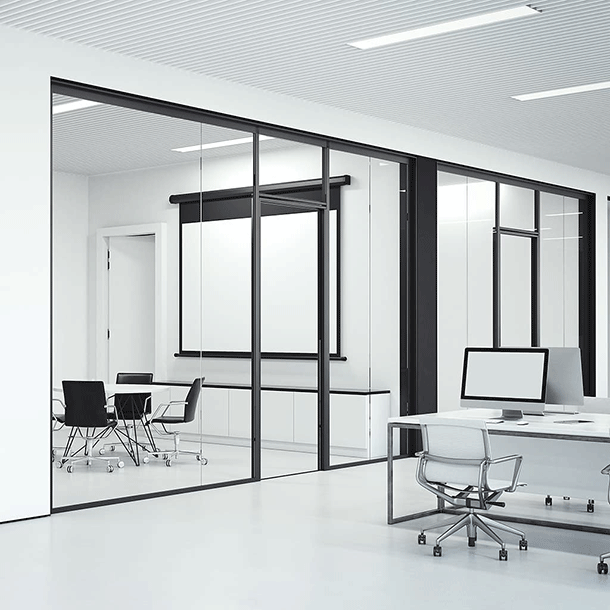
For acousticians optimizing office environments, subjective impressions are not enough. Clients want evidence, standards bodies require it, and the most effective designs are built on a foundation of measurable, trackable acoustic parameters. Yet a surprisingly common shortcut persists: specify an STC 45 partition, call the acoustic design done, and move on. STC is easy to specify and gives clients a number to point at — but it tells you almost nothing about whether speech privacy is actually achieved. A partition performs within an acoustic environment, not in isolation, and if that environment is not doing its part, even an excellent wall will not save you. That is why understanding the full set of metrics that validate open-plan acoustic performance is essential to designs that actually work.
1. Reverberation Time (RT60): The Backbone of Room Acoustics
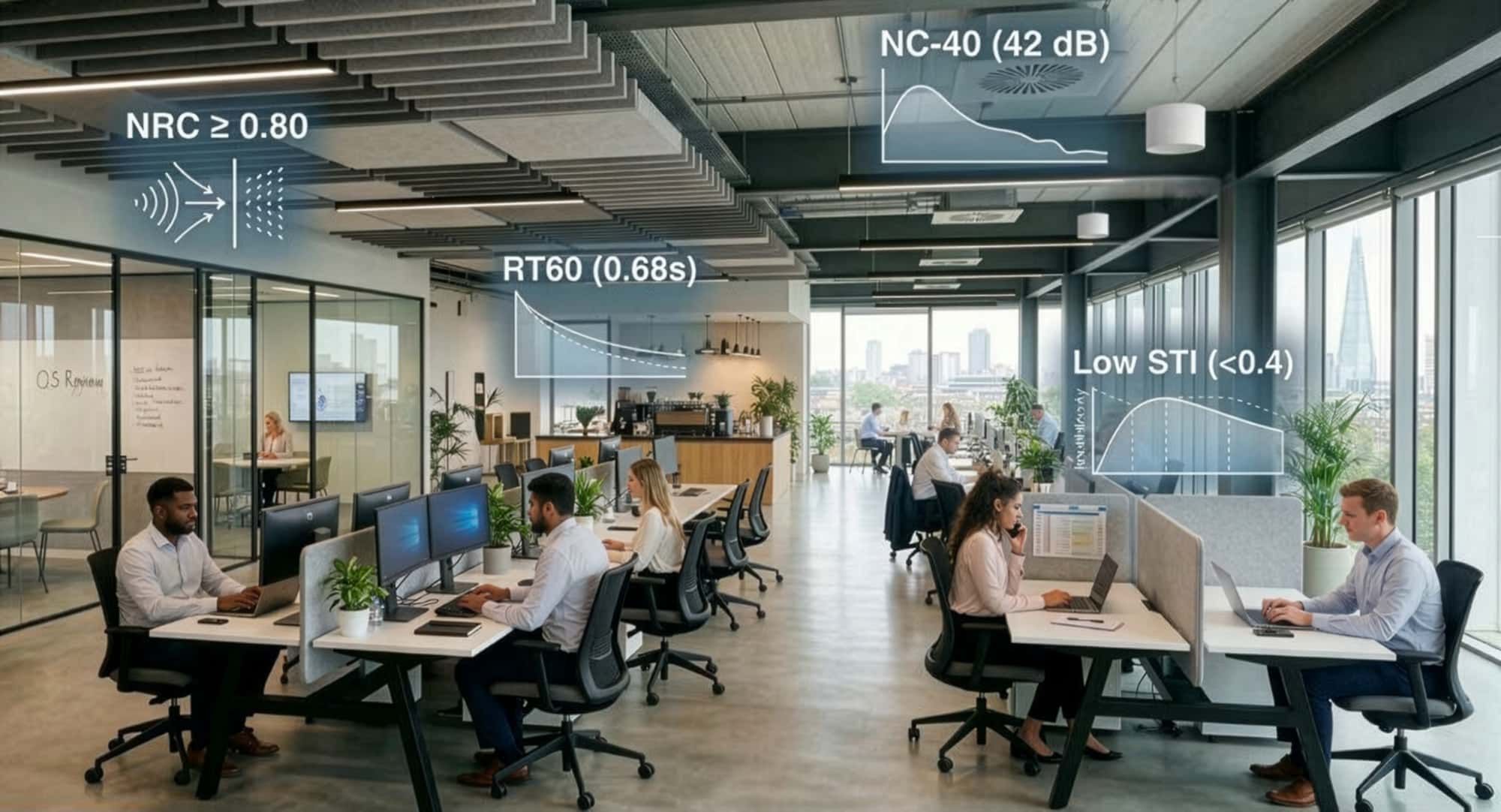
RT60 measures how long it takes for sound energy to decay by 60 dB after a source stops — essentially, how long a room rings. It is the most universally tracked acoustic metric, and for good reason: it directly influences speech clarity, occupant fatigue, and overall spatial comfort.
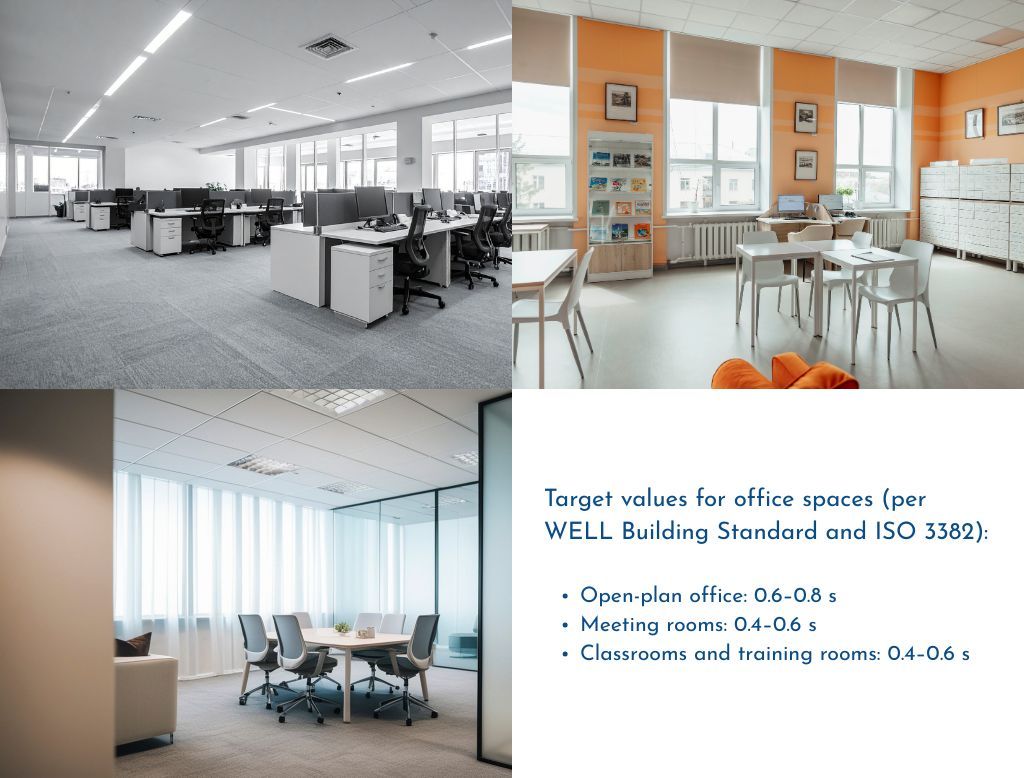
Target values for office spaces per WELL Building Standard and ISO 3382:
- Open-plan office: 0.6–0.8 s
- Meeting rooms: 0.4–0.6 s
- Classrooms and training rooms: 0.4–0.6 s
When RT60 is tracked across octave bands using ISO 3382 methodology, you gain a full spectral picture of room behavior — enabling precise material specification and layout validation well before construction begins.
2. Noise Criteria (NC): Quantifying Background Noise Levels
Noise Criteria (NC) curves measure the steady-state background noise generated by HVAC systems, equipment, and external intrusions. For concentration-intensive office environments, NC-35 to NC-40 (approximately 40–46 dB LAeq) is the standard target. Excessive background noise masks speech in ways that are uncontrolled and unpredictable, driving vocal effort up and cognitive performance down. Establishing a clean NC baseline is the essential first step before any active acoustic strategy is layered in.
3. STC and SPC: Why Your Partition Doesn't Work Alone
Sound Transmission Class (STC) rates how well a partition attenuates airborne sound. STC-45 is the common private office benchmark, STC-50+ for sensitive environments requiring more confidentiality. It's the metric designers reach for first and the one clients most frequently cite. It's also, on its own, an incomplete picture.
Whether a partition delivers speech privacy depends critically on the ambient noise level present on the receiving side. In a quiet space, NC-25 or lower, even an STC-50 wall may be insufficient. A higher ambient sound floor makes the same partition perform meaningfully better in practice.
Two metrics quantify this relationship directly. Speech Privacy Potential (SPP) establishes that the sum of partition isolation and background sound level in the receiving space should be 75 or more to achieve adequate acoustic privacy. Speech Privacy Class (SPC) builds on this with greater precision, applying frequency-weighted signal-to-noise ratios across 1/3 octave bands to estimate the statistical likelihood of privacy lapses. For most office construction projects, SPP defines the design target while SPC provides the scientific evidence to support it.
The practical implication is direct: a more modest partition paired with a well-managed ambient sound floor can achieve the same speech privacy outcome as an over-specified wall in an acoustically neglected environment — and at significantly lower cost. This is why WELL Building Standard v2 addresses both acoustic separation and ambient sound levels together, not as independent variables.
4. Speech Transmission Index (STI): Balancing Clarity and Privacy
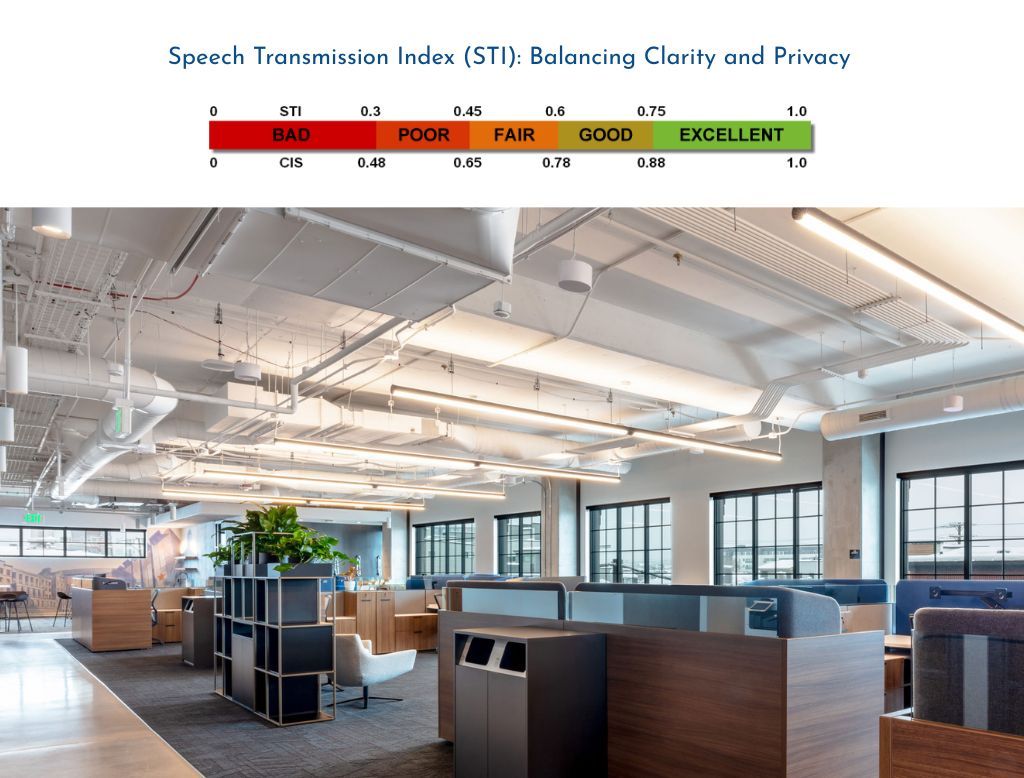
The Speech Transmission Index (STI) runs from 0 to 1 and quantifies how intelligible speech remains as it travels through a space. In office acoustic design, STI cuts both ways:
- High STI (0.6–0.8+): Required in meeting rooms, training spaces, and collaboration zones where communication clarity is essential.
- Low STI (<0.4): Desirable in open-plan areas where reduced speech intelligibility supports focus and privacy.
STI is where sound masking has its most direct and measurable impact. A well-tuned masking system can meaningfully reduce STI across open-plan areas, converting a nominally acceptable design into a genuinely high-performing one. Measuring STI before and after masking deployment is increasingly standard practice for this reason.
5. Material Absorption (NRC / αw): Quantifying Your Specification Decisions
Noise Reduction Coefficient (NRC) and weighted sound absorption coefficient (αw) describe how effectively a material absorbs sound rather than reflecting it, on a scale from 0 (fully reflective) to 1 (fully absorptive). Materials with NRC ≥ 0.80 — high-density acoustic panels, suspended baffles, and performance ceiling tile systems — deliver substantial RT60 reduction in open environments. Tracking NRC values across specified surfaces allows reverberation to be modeled and design performance validated before a single panel is installed.
6. Clarity (C50), Definition (D50), and Early Decay Time (EDT)
For higher-complexity projects — large open offices, multi-use environments, or spaces with variable occupancy — these metrics add diagnostic depth beyond what RT60 alone can reveal. C50 values above +2 dB correlate strongly with perceived speech intelligibility. D50 above 0.5 supports comprehension in reverberant fields. Early Decay Time (EDT) captures the perceptual influence of early reflections and serves as a meaningful complement to RT60 in occupied conditions. Together, these parameters explain why two rooms with identical RT60 readings can feel acoustically very different — and where to intervene when they do.
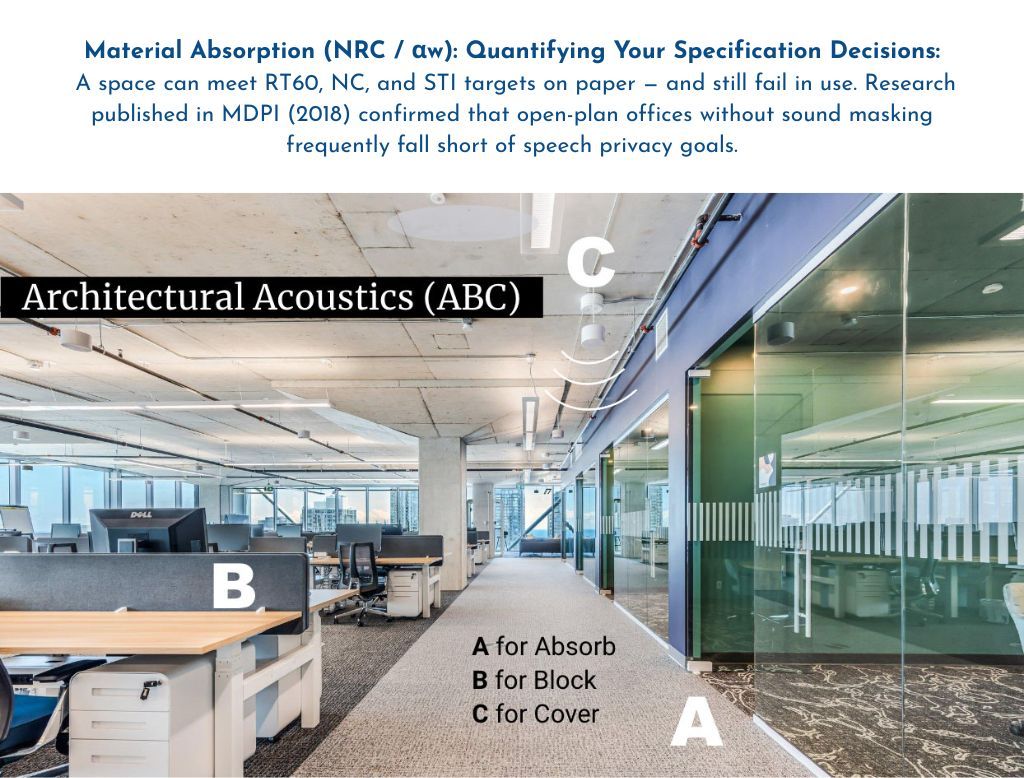
7. Sound Masking and Adaptive Volume Control: Closing the Performance Gap
A space can satisfy RT60, NC, and STI targets on paper and still underperform in use. Research published in MDPI (2018) confirmed that open-plan offices without sound masking frequently fall short of speech privacy goals even when passive acoustic metrics are nominally on target. This is where active acoustic systems move from optional enhancement to essential specification.
Sound masking introduces a calibrated broadband signal — typically shaped to a modified speech spectrum — that raises the ambient noise floor in a controlled, perceptually comfortable way. The result is a measurable reduction in speech intelligibility at distance, improved concentration, and greater perceived privacy without dependence on physical barriers alone.
Static masking levels, however, are not sufficient in dynamic office environments. Occupancy fluctuates throughout the day, HVAC output varies with thermal load, and the acoustic profile of a quiet morning bears little resemblance to a busy afternoon. Adaptive volume control systems respond to these shifts in real time, automatically adjusting masking output to maintain the designed acoustic conditions across the full working day. This is the mechanism that closes the gap between measured performance and lived experience — which is, ultimately, what clients are paying for.
Putting the Metrics Together
Effective office acoustic design is not a single-metric exercise. RT60 establishes spatial character, NC sets the noise floor baseline, STI quantifies the clarity-privacy balance, and NRC drives material specification. Advanced parameters like C50 and EDT add diagnostic precision where complexity demands it. Sound masking particularly with adaptive volume control — is the layer that ensures measured performance translates into consistent real-world results.
Used together, these metrics give acousticians the objective evidence to validate a design, defend specification decisions, and deliver environments where people can genuinely focus, communicate, and collaborate.
References
ISO 3382-3:2022 — Acoustics: Measurement of room acoustic parameters in open-plan offices.
WELL Building Standard v2, Feature 72 (Acoustic Design) — International WELL Building Institute (IWBI).
ANSI/ASA S12.60-2010 — Acoustical Performance Criteria, Design Requirements, and Guidelines for Schools.
IEC 60268-16:2020 — Sound System Equipment: Objective Rating of Speech Intelligibility by the Speech Transmission Index.
Haapakangas, A. et al. (2018). "Effects of sound masking on workers in open-plan offices." MDPI Applied Sciences.
ekko Acoustics — RT60 and Speech Clarity in Commercial Interiors (technical guidance).
IBA Online — Noise Criteria (NC) Curves and workplace acoustic comfort targets.