For acousticians optimizing office environments, subjective impressions are not enough. Clients want evidence. Standards bodies require it. And the most effective designs — especially those incorporating sound masking — are built on a foundation of measurable, trackable acoustic parameters. Here is a practical guide to the key metrics that validate open-plan office acoustic performance, with a focus on what they mean in real-world applications.
1. Reverberation Time (RT60): The Backbone of Room Acoustics
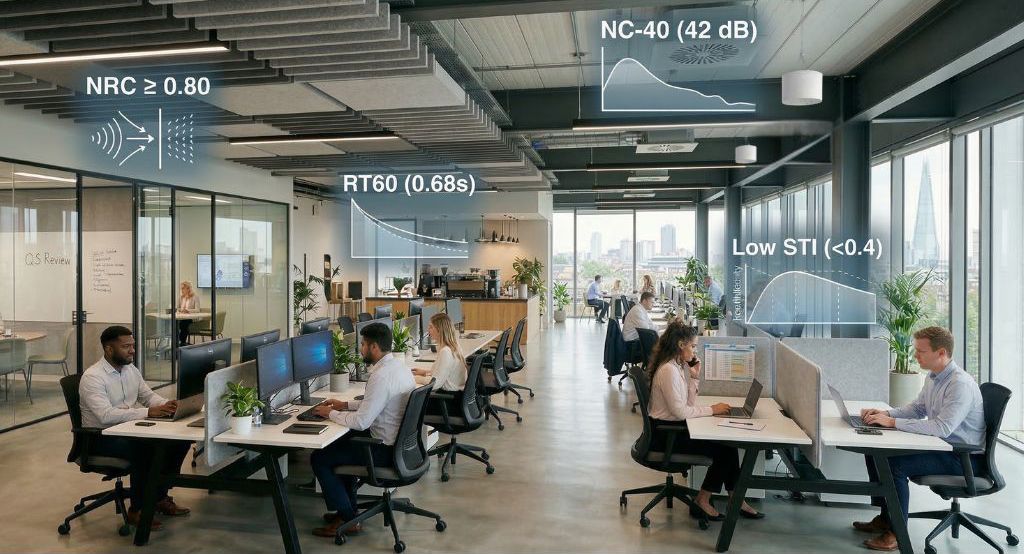
RT60 measures how long it takes for sound energy to decay by 60 dB after a source stops — essentially, how long a room "rings." It is the most universally tracked acoustic metric, and for good reason: it directly influences speech clarity, occupant fatigue, and overall spatial comfort.
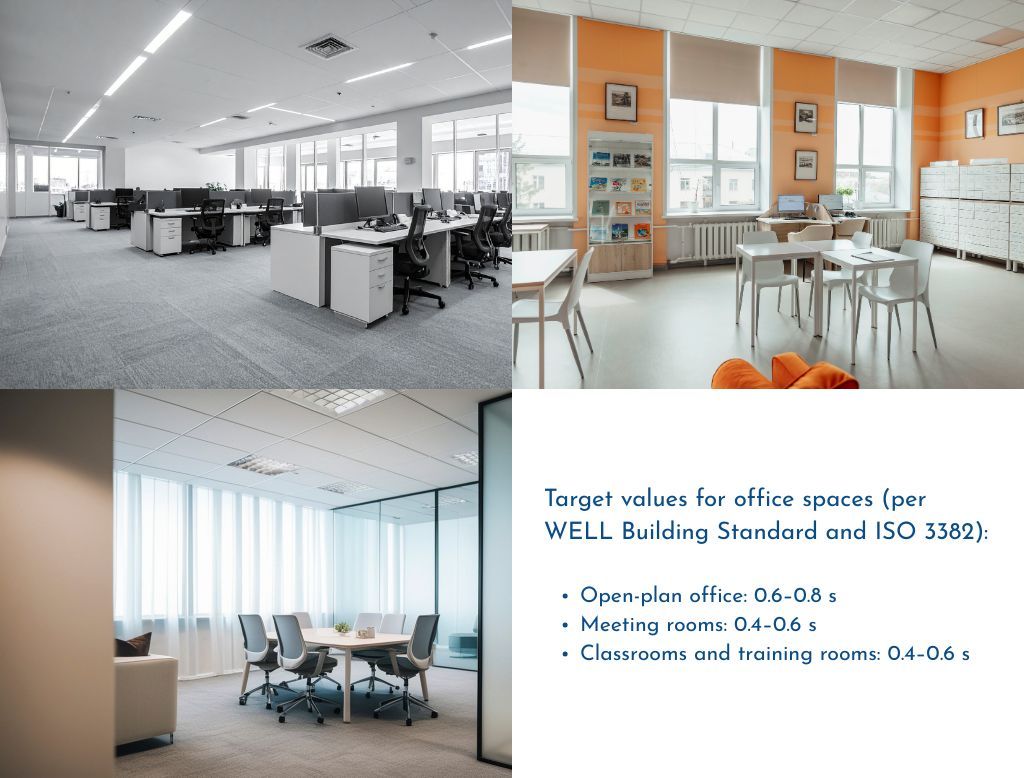
Target values for office spaces (per WELL Building Standard and ISO 3382):
- Open-plan office: 0.6–0.8 s
- Meeting rooms: 0.4–0.6 s
- Classrooms and training rooms: 0.4–0.6 s
When RT60 is tracked across octave bands using ISO 3382 methodology, you gain a full spectral picture of room behavior — enabling precise material specification and layout validation long before construction is complete.
2. Noise Criteria (NC): Quantifying Background Noise Levels
Noise Criteria (NC) curves measure the steady-state background noise generated by HVAC systems, equipment, and external intrusions. In office acoustic design, NC-35 to NC-40 (approximately 40–46 dB LAeq) is the standard target for concentration-intensive environments. Excessive background noise masks speech in ways that are uncontrolled and unpredictable, driving vocal effort up and cognitive performance down. Establishing a clean NC baseline is the first step before layering in any active acoustic strategy.
3. Speech Transmission Index (STI): Balancing Clarity and Privacy
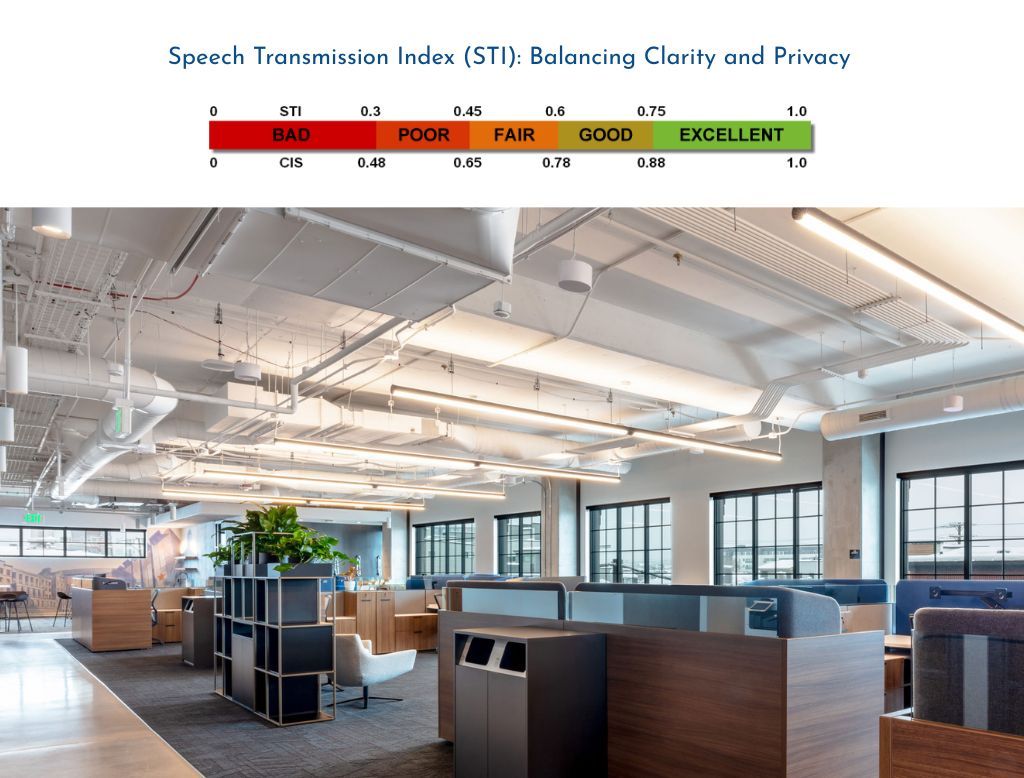
The Speech Transmission Index (STI) runs on a scale from 0 to 1 and measures how intelligible speech remains as it travels through a space. In office acoustic optimization, STI cuts both ways:
- High STI (0.6–0.8+): Required in meeting rooms, training spaces, and collaboration zones where clear communication is essential.
- Low STI (<0.4): Desirable in open-plan areas where speech privacy reduces distraction and improves focus.
STI is where sound masking has its most direct, measurable impact. A well-tuned masking system can meaningfully reduce STI in open areas — transforming a nominally acceptable design into a genuinely high-performing one. This is why STI measurement before and after masking deployment is increasingly standard practice.
4. Material Absorption (NRC / αw): Quantifying Your Specification Decisions
Noise Reduction Coefficient (NRC) and weighted sound absorption coefficient (αw) describe how effectively a material absorbs sound rather than reflecting it, on a scale from 0 (fully reflective) to 1 (fully absorptive). Materials with NRC ≥ 0.80 — such as high-density acoustic panels, suspended baffles, and certain ceiling tile systems — provide substantial RT60 reduction in open spaces. Tracking NRC values across your specified surfaces lets you model expected reverberation and validate design performance before installation.
5. Clarity (C50), Definition (D50), and Early Decay Time (EDT)
For acousticians working on higher-complexity projects — large open offices, multi-use environments, or spaces with variable occupancy — these nuanced metrics add diagnostic depth beyond RT60. C50 (clarity for speech) values above +2 dB correlate strongly with perceived intelligibility. D50 (definition) above 0.5 supports speech understanding in reverberant fields. Early Decay Time (EDT) reflects the influence of early reflections and provides a perceptually meaningful complement to RT60. Together, these metrics help explain why two rooms with identical RT60 values can feel acoustically very different.
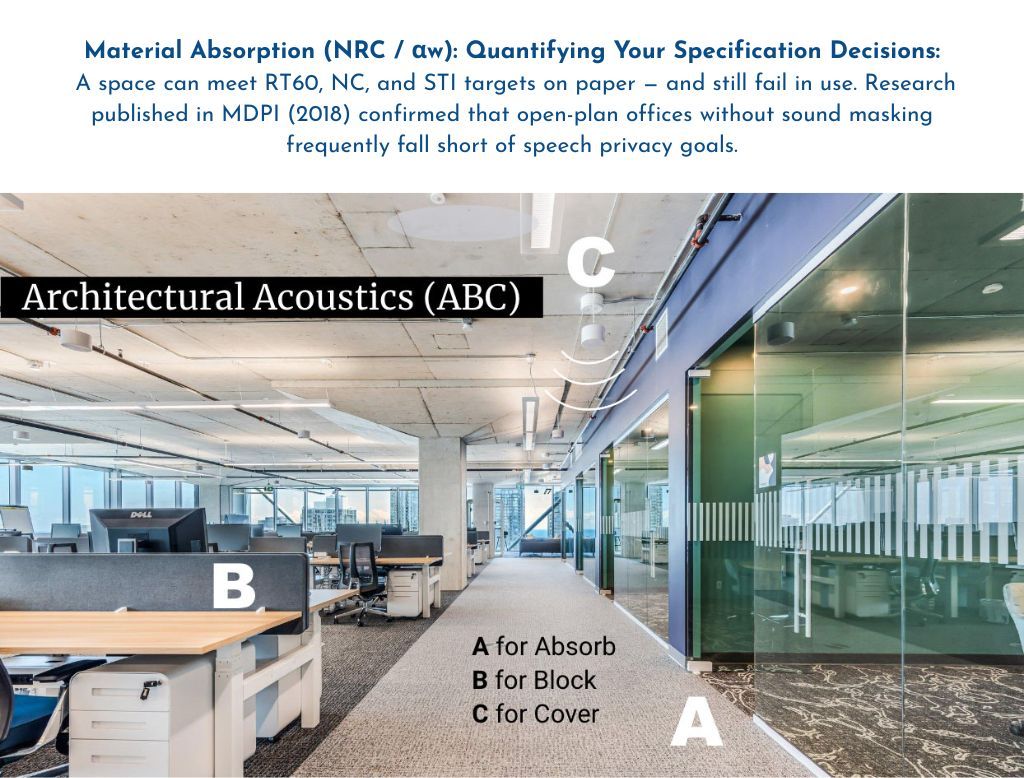
6. Sound Masking and Adaptive Volume Control: Closing the Performance Gap
Here is a reality that experienced office acousticians encounter regularly: a space can meet RT60, NC, and STI targets on paper — and still fail in use. Research published in MDPI (2018) confirmed that open-plan offices without sound masking frequently fall short of speech privacy goals even when passive acoustic metrics are nominally acceptable. This is where active acoustic systems become an essential specification element, not an optional add-on.
Sound masking introduces a calibrated broadband background signal — typically shaped to a modified speech spectrum — that elevates the ambient noise floor in a controlled, comfortable way. The result is a measurable reduction in speech intelligibility at distance, improved concentration, and greater perceived privacy without relying solely on physical barriers.
Critically, static masking levels are not sufficient in dynamic office environments. Occupancy shifts throughout the day, HVAC output varies with load, and noise profiles change between a quiet morning and a busy afternoon. Adaptive volume control systems automatically adjust masking output in real time in response to ambient conditions — ensuring that the designed acoustic environment is actually delivered consistently, across the full working day. This closes the gap between measured performance and lived experience, which is ultimately what clients are paying for.
Putting the Metrics Together
Effective office acoustic design is not a single-metric exercise. RT60 establishes spatial character, NC sets the noise floor baseline, STI quantifies the clarity-privacy balance, and NRC drives material specification. Advanced metrics like C50 and EDT add diagnostic precision for complex projects. Sound masking — particularly with adaptive volume control — is the layer that ensures those measurements translate into consistent, real-world performance. Used together, these parameters give acousticians the objective evidence to prove a design works, defend specification decisions, and deliver environments where people can actually think.
References
ISO 3382-3:2022 — Acoustics: Measurement of room acoustic parameters in open-plan offices.
WELL Building Standard v2, Feature 72 (Acoustic Design) — International WELL Building Institute (IWBI).
ANSI/ASA S12.60-2010 — Acoustical Performance Criteria, Design Requirements, and Guidelines for Schools.
IEC 60268-16:2020 — Sound System Equipment: Objective Rating of Speech Intelligibility by the Speech Transmission Index.
Haapakangas, A. et al. (2018). "Effects of sound masking on workers in open-plan offices." MDPI Applied Sciences.
ekko Acoustics — RT60 and Speech Clarity in Commercial Interiors (technical guidance).
IBA Online — Noise Criteria (NC) Curves and workplace acoustic comfort targets.