As we close out 2025, one lesson is clear: today’s workplace must be intentionally designed to support how people actually work — not just how organizations once imagined they should work. In a year defined by hybrid schedules and renewed focus on employee experience, office acoustics, office design, and workplace optimization have emerged as core determinants of productivity, well-being, and retention.
Gensler’s landmark 2025 Global Workplace Survey, which drew insights from over 16,000 office workers across 15 countries, makes it unmistakable that modern workplaces are judged less on square footage and more on how well they support people’s needs — especially control over their environment, including noise levels and privacy. (Gensler)
One of the strongest signals this year remains the persistent gap between employee expectations and reality. While many employees are back in offices more frequently, studies show that noise and productivity barriers remain a significant drag. Only about 32 % of workers report satisfaction with office noise levels, ranking acoustic comfort among the lowest-rated workplace attributes. (Forbes)
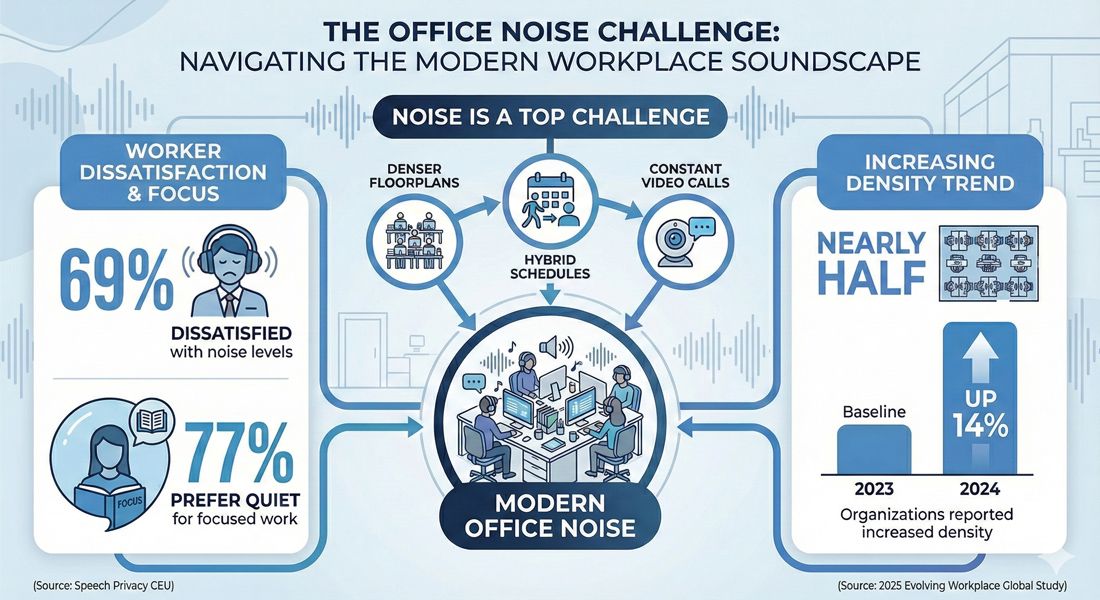
This dissatisfaction has real consequences for workplace optimization: surveys reveal that a large share of workers are unhappy with how noise impacts their focus and job performance. For example, around 69 % of employees report dissatisfaction with noise at their primary workspace, and 77 % express a preference for quiet when they need to focus. (LinkedIn) These numbers are echoed in independent research showing that poor acoustic environments — especially in open-plan offices — significantly correlate with lower perceived fit of office spaces for work activities. (Acoustic Bulletin)
Further complicating the narrative, data from workplace experience research indicates that while the average Leesman Index employee experience score improved from 64.3 in 2019 to 69.5 by 2024, the experience gap between remote and office work remains notable — with work-from-home environments still scoring about 10 points higher on experience than in-office spaces. (leesmanindex.com) This suggests that many offices still fall short in delivering the quiet, distraction-free settings employees increasingly need.
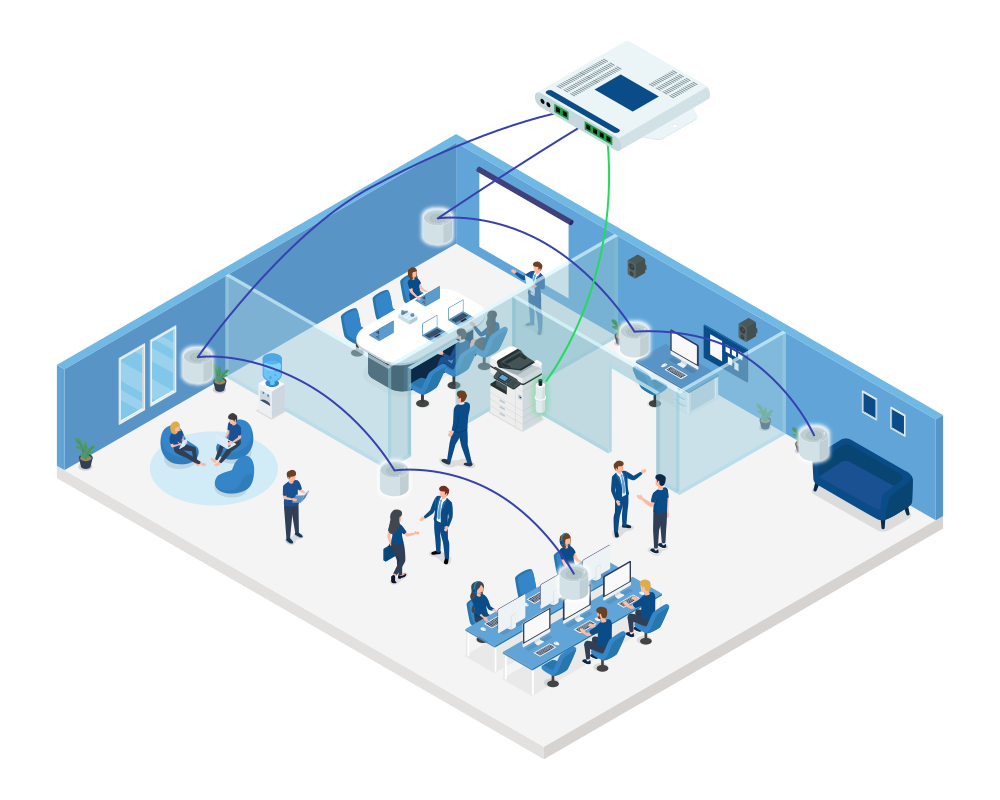
But 2025 also brought clarity about what works. Evidence consistently shows that intentional acoustic planning — including absorptive materials, designated quiet zones, and sound masking — measurably enhances workplace performance. Acoustic interventions have been linked to 20–30 % improvements in focus and task accuracy compared to untreated spaces, underscoring the productivity payoff of thoughtful office design and sound management. (researchtrendsjournal.com)
As a result, workplace designers and organizations are shifting toward human-centric design strategies that integrate acoustics from the outset. Flexible environments that combine collaborative zones with quiet areas, natural elements, and adjustable sound controls are not just aesthetic trends — they are core to creating spaces where people can concentrate, interact, and innovate without compromise.

Fig. 1. The proportion of respondents dissatisfied with key IEQ factors in different office types. Adapted from Radun, Hongisto, 2023.
Looking ahead, leaders in workplace optimization must treat acoustics as fundamental — not optional. Integrating sound management into office design and equipping spaces with appropriate acoustic solutions will be crucial in designing workplaces that people choose, not just tolerate.
Meaningful gains in productivity and employee satisfaction come when acoustic comfort and intentional design are elevated to strategic priorities in workplace planning.
Interested in optimizing your workplace for 2026? Contact us for a workplace acoustic audit or visit Soft dB at upcoming industry events to learn how evidence-based acoustic strategies can transform your spaces.
References
- Gensler Research Institute — 2025 Global Workplace Survey (2025)
- Leesman Research & Insights Team (2025) — The workplace why
- Forbes (2024/2025 context) — A Noisy Office Is A Nuisance — And A Business Opportunity
- Haworth LinkedIn post (2025) — Noise is one of the top challenges…
- Research Trends Journal (2025) — Noise Reduction and Productivity